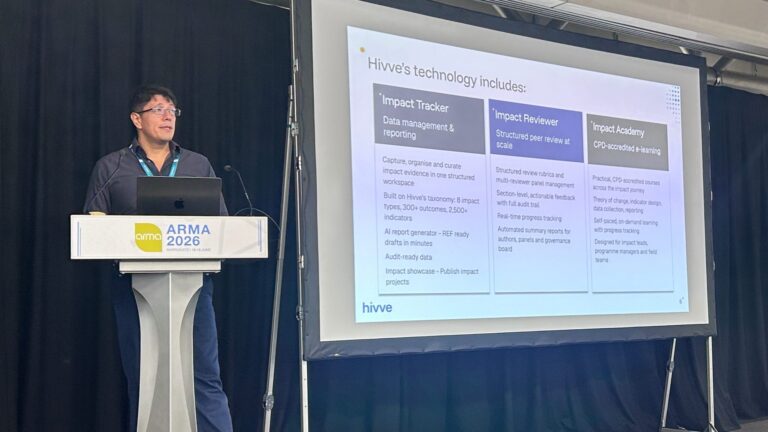
Going to ARMS this year was particularly interesting because the Australian higher education sector is in an unusual position. The previous Excellence in Research for Australia (ERA) and Engagement and Impact (EI) exercises have ceased, and the Australian Research Council (ARC) is developing its proposed Research Insights Capability. Their intention is to create a more flexible, data-driven approach that makes greater use of existing information while reducing unnecessary reporting burden. More than 50 consultation sessions were held in 2025, alongside more than 30 written submissions, as the ARC explored what this new approach could look like (ARC, 2026a).
That uncertainty was apparent in many of my conversations at ARMS. Some universities are continuing their impact preparations, broadly on the assumption that demonstrating research impact, and telling the story of that impact in some form, will remain important. In others, dedicated funding and activity have understandably reduced while they wait for greater certainty. Attention has moved to more immediate priorities and opportunities: securing research funding, responding to major strategic initiatives and, un/surprisingly, working out how AI can be used effectively across research and research management.
There are also significant new funding opportunities on the horizon. In June 2026, for example, Australia and the EU concluded negotiations for Australia to associate with Pillar II of Horizon Europe, the EU’s €93.5 billion research and innovation programme (European Commission, 2026).
All of this left me thinking about a broader question: without a national assessment exercise providing the structure and impetus, how do universities continue to understand, evidence and communicate the impact their research is having?
For me, this matters because impact reporting has value well beyond a national assessment. Research managers need to understand where impact is emerging, where evidence needs strengthening and where additional support could help researchers increase the reach and significance of their work. At an institutional level, universities need credible evidence of the difference their research is making, not only for assessment, but for funders, partners, government, strategy and their wider accountability to society.
A national assessment provides an important framework and reason for bringing that evidence together. The opportunity is to make sure the work involved creates value beyond the assessment itself.
Impact hasn’t gone away
One of the interesting things about the current Australian situation is that impact hasn’t disappeared. It is simply appearing in different places.
Researchers are already being asked to think about impact when applying for funding. For the 2026 NHMRC Investigator Grants round, 20% of the assessment relates to research impact and pathway to impact: 10% for the reach and significance of the impact and 10% for the applicant’s contribution to it. The revised approach specifically shifts attention towards the applicant’s contribution to realising, sustaining or maximising impact along a pathway to impact (NHMRC, 2026).
The same was apparent in the practical use cases people raised with me at ARMS: grant applications, interim and end-of-grant reporting, major strategic initiatives, government funding, annual appraisal and promotion, Higher Degree Research training, institutional communications and impact case studies for university websites. Vice-Chancellors need compelling examples when speaking with government and other stakeholders; research offices want to identify promising impact stories and support researchers to develop them; institutes and centres need to demonstrate progress against their objectives; and funders want to understand what happened as a result of the research they supported.
These can look like separate activities owned by different parts of an institution, but they are all drawing on versions of the same underlying information. What difference are we trying to make? What is actually happening? What evidence do we have? And what should we do next?
At what point do all these dots join up?
Have we focused too much on reporting impact?
For a long time, much of the infrastructure around research impact has understandably been developed in response to external reporting and assessment requirements. An assessment creates a deadline, a specification and, importantly, institutional attention and resources.
The UK provides perhaps the clearest example. REF 2014 was the first UK national research assessment to formally assess research impact beyond academia, resulting in 6,975 impact case studies demonstrating effects and benefits across the economy, society, culture, public policy, health, the environment and quality of life. Impact case studies were used again in REF 2021, creating an extraordinary evidence base showing the difference university research can make (UKRI, 2022a; UKRI, 2023).
But there is an important distinction between reporting impact and understanding impact. Good reporting requires us to understand what has happened and demonstrate it credibly. The opportunity is to make that understanding useful before, during and after a particular reporting exercise.
Rather than only asking what evidence is required for the next submission, universities can also ask: what impact are we trying to achieve? Where is it already emerging? What are we learning? Where could additional support increase reach or significance? And what should we do differently as a result?
Those questions matter whether or not there is a national assessment underway.
Better data can help, but it can’t tell us everything
There is good reason to think answering these questions should become easier. OpenAlex, ORCID, ROR, DOIs and the wider adoption of persistent identifiers mean that information which previously had to be manually assembled can increasingly be connected and reused.
If information already exists, we should use it. If it can be captured once and reused rather than repeatedly entered into different reporting systems, even better. And where quantitative data can tell us something meaningful about reach, uptake, collaboration, translation or outcomes, it should absolutely form part of the picture.
But we have known for some time that data and indicators alone cannot capture the full breadth of research impact.
The UK’s Metric Tide review remains particularly relevant. Published in 2015, it did not argue against metrics; rather, it argued for their responsible use. Its conclusion was that metrics should support rather than replace expert judgement, and that quantitative indicators can usefully complement other forms of evaluation when they are carefully selected and applied in context (Wilsdon et al., 2015).
That makes sense when we think about the diversity of research impact. Research can change clinical practice, influence legislation, create a company, protect an ecosystem, improve education, change professional practice or alter how people understand an issue. We should expect the evidence of those changes to look different.
The availability of more data therefore doesn’t mean everything that matters can, or should, be reduced to a common metric. The challenge is to combine quantitative information with qualitative evidence and expert judgement so that we get a credible picture of what is really happening.
Are we looking for common indicators at the wrong level?
Our own experience at Hivve has made me think differently about this question.
When we worked on the original methodology behind the Times Higher Education Impact Rankings, one of the challenges was finding outcome indicators that universities operating in very different contexts around the world could all feasibly and consistently report. In Theory of Change terms, many measures inevitably had to sit closer to activities, outputs and proxies than the ultimate societal outcomes we might ideally have wanted to understand.
More recently, our work developing impact frameworks with research funders and philanthropic foundations has shown us the other side of the problem. When an organisation has a clear Theory of Change, it is possible to develop a meaningful core set of indicators that helps it understand progress towards the outcomes it is trying to achieve.
There is a fundamental difference between trying to create universal metrics against which every type of research impact can be assessed and developing indicators that help an organisation understand whether it is achieving the outcomes it exists to create.
If an organisation is clear about its mission, we can ask what we would expect to change if its strategy is working, what would indicate progress, what quantitative information would help us understand the scale of that change, and what qualitative evidence would help us understand how and why it happened.
This makes me wonder whether we are sometimes looking for common indicators at the wrong level.
A university will generate an extraordinary breadth of impacts, so trying to reduce all of them to a universal shopping list of metrics is unlikely to tell us very much. But a university also has a mission and a strategy. It chooses research priorities, establishes institutes and centres, enters partnerships and decides where to invest people, funding and infrastructure.
If the outcomes behind those ambitions aren’t clearly articulated and evidenced, how does an institution know whether it is making the progress it wants to make?
Impact reporting needs to start with what we want to understand
Impact reporting does create work. Creating impact, building relationships, monitoring progress and collecting credible evidence of outcomes all take time. Yet while researchers are increasingly expected to describe their intended impact when applying for funding and demonstrate it later, the monitoring, evaluation and learning (MEL) needed in between is not always adequately funded or given sufficient time.
We should absolutely reuse existing information where it is relevant and avoid asking researchers to report the same things repeatedly. But we also need to be careful that what is easiest to access doesn’t determine what we measure. If we want to understand whether meaningful change has occurred, new evidence will often need to be deliberately collected from partners, beneficiaries, policymakers, practitioners or others experiencing that change.
This comes back to the connection between organisational strategy, intended outcomes and measurement. Universities, research centres and funders need to be clear about the outcomes they are trying to achieve, determine what they need to know to understand progress, and then identify the indicators and evidence required. Some of that evidence will already exist; some will need to be collected. If organisations want to understand and demonstrate impact, the time, capability and resources required to do that well need to be part of the equation.
Technology can make this considerably easier by reusing information, connecting data and reducing the burden of turning evidence into reporting. But it cannot remove the need to collect the right evidence in the first place. This is also where I think AI becomes genuinely interesting, as a way of helping us make much better use of that evidence.
Could AI help us move from reporting to understanding?
There is understandably a lot of discussion about AI and research impact, from how AI might be used in research assessment to the impacts of AI-enabled research itself. But there is another, more practical question: could AI help us make better use of the impact information and evidence we already have?
This is something we have been exploring at Hivve through our AI Impact Report Generator. Using research outputs, project information and supporting evidence, it can produce a good first draft of an impact case study in minutes rather than days. That time saving matters, particularly given the burden associated with impact reporting, but for me it isn’t the most interesting part.
Alongside the draft, the AI provides detailed, specific feedback on the individual case, identifying where the impact story and supporting evidence could be strengthened. That gives researchers and research support teams something concrete to discuss: how could the reach of this impact be extended? How could its significance be increased? What evidence would make the claims stronger? What is currently missing, and what could happen next?
We initially developed and tested this approach against the UK’s REF impact case study format, where reach and significance are central to impact assessment. But what interests me increasingly is what happens when we apply the same principle beyond a single assessment exercise. A first draft produced in minutes is useful; using the feedback to help develop the impact itself is much more valuable.
This changes where the report sits in the process. Rather than being only the final product, assembled retrospectively because somebody has asked for it, it can become a working tool. Researchers and research support teams can use the draft and feedback to understand what they have, identify gaps, decide what evidence or activity to prioritise and revisit the impact story as it develops.
There are important limits. AI cannot determine that an impact claim is true simply because it can write a convincing narrative, nor should it replace expert judgement. The quality of any AI impact reporting will depend on the quality, context and completeness of the underlying information and evidence. This is consistent with the broader lesson from our years of experience and other leading sources of information such as The Metric Tide: technology and quantitative information can support better assessment and decision-making, but evidence, context and human judgement remain essential.
For me, the bigger opportunity therefore isn’t simply faster reporting. It is whether AI, better-connected data and more continuous evidence capture can help us move away from periodically reconstructing impact towards understanding and developing it as it happens.
From reporting impact to managing for impact
If we can do that across a portfolio, the opportunity becomes much bigger than producing better reports.
Universities could begin to see where impact is emerging, where evidence needs strengthening, where additional support could increase reach or significance and where further investment could make a difference. They could understand which partnerships are creating value, which areas of research are translating into meaningful outcomes, where expected outcomes are not yet appearing, and where important work is happening that the institution simply doesn’t know enough about.
That is where portfolio-level impact measurement becomes genuinely useful. The purpose isn’t to produce one institutional impact score. It is to make enough of the impact happening across an organisation visible that people can understand it and make better decisions.
At a time when resources are constrained, competition for funding is intense and new opportunities such as Horizon Europe are opening up, that understanding becomes increasingly valuable.
National assessment provides an important reason and structure for reporting impact, but the value of understanding impact extends well beyond an assessment exercise. If universities can bring together credible evidence of the difference their research and wider activity are making, that evidence can support funding applications and reporting, help research managers identify where further support is needed, inform institutional strategy and investment, and provide a clearer picture of where the university is delivering against its mission.
This doesn’t mean moving away from impact reporting. It means getting more value from the work that goes into it. Rather than evidence being assembled for a particular exercise and then becoming static, it can be built and strengthened over time, used to develop impact and drawn on for different purposes as they arise.
Perhaps, then, the question isn’t simply how should universities report their impact? It is also: what impact are we trying to create, what impact are we actually having, how do we know, and what are we going to do with that knowledge?
For me, that is the opportunity: to connect reporting impact with understanding, developing and ultimately managing for impact.
Responses (0)
No responses yet. Yours would be the first.