
Preparing a strong REF impact case study takes more than writing a compelling account of what research has achieved.
It means understanding what changed, demonstrating the research’s contribution and having credible evidence to support the claims.
For REF 2029, the importance of collecting that evidence throughout the impact journey cannot be overstated.
Much of the most valuable evidence sits outside universities, with the organisations, practitioners, policymakers and communities whose work or lives have been influenced by research.
The challenge is making sure that evidence is captured while the relationships and experiences are still fresh.
What has changed for REF 2029?
Engagement and Impact accounts for 25% of the overall REF 2029 assessment, compared with 25% for impact in REF 2021.
The assessment continues to focus on the reach and significance of impact, with some important changes to the requirements.
One significant change is the removal of the previous 2-star quality threshold for underpinning research.
This recognises that research meeting the REF definition of research can contribute to meaningful impact, even where it does not meet the former threshold.
The guidance also encourages institutions to explain how engagement activities and responsible practices contributed to the development of impact.
The familiar impact case study structure remains, but the emphasis on demonstrating credible impact is as important as ever.
For research offices, the practical question is straightforward:
Do we have the evidence needed to demonstrate the impact we are describing?
The official REF 2029 Engagement and Impact guidance provides the detailed requirements.
Why external corroboration matters
An impact case study may describe research that influenced policy, improved professional practice, changed organisational behaviour or delivered benefits to communities.
But the institution’s account of that impact is not, on its own, sufficient corroboration.
REF 2029 requires appropriate sources of information external to the submitting higher education institution to corroborate specific claims.
These may include public reports, confidential documents, factual statements from beneficiaries or individuals who can be contacted to verify what happened.
The distinction matters.
A university may have excellent records of its research activities, engagement events and publications.
However, the strongest evidence of what changed may be held by the people and organisations that used the research.
For example, a public-sector organisation might explain how research informed a decision. A professional body could document changes to its guidance. A community organisation might provide evidence of benefits experienced by the people it supports.
The important question is not simply whether a source mentions the research.
It is whether the source helps corroborate the specific impact being claimed.
What are the requirements for corroborating contacts?
REF 2029 allows institutions to identify individuals who can corroborate impact claims.
A maximum of five individuals may be entered as sources for each impact case study.
This is a maximum, not a target.
Where an individual is identified as a corroborating contact, their personal details must be entered separately into the REF submission system.
The published case study should identify the relevant organisation and, where appropriate, the person’s position, together with the claims they can corroborate.
Institutions should ensure that individuals understand how their information will be used and have appropriate consent and data-handling arrangements in place.
Not every case study will need five contacts. Nor does every corroborating source need to be an individual.
The objective is to provide sufficient, appropriate evidence for the claims being made.
Why waiting until 2028 could be a mistake
Impact often develops over several years.
A researcher may work closely with an external organisation during a project, helping to shape policy, practice or services.
At the time, the relationship is active and the people involved understand what happened.
Two or three years later, circumstances may have changed.
Contacts may have moved organisations. Project teams may have changed. Documents may be harder to locate. People may struggle to recall the detail needed to explain how the research contributed to a particular outcome.
External partners may also receive multiple requests for testimonials as the REF deadline approaches.
Some will have limited capacity to respond.
This is why collecting corroboration should not be treated as an administrative exercise left until the final stages of REF preparation.
It is part of good impact management.
The best time to capture evidence is often when the change happens, not when the case study is being written.
What does good impact evidence look like?
Strong evidence is not necessarily complicated.
It should help answer three questions.
What changed?
Be specific about the outcome.
Rather than simply stating that research informed professional practice, explain what changed in that practice and who was affected.
How did the research contribute?
Describe the relationship between the research and the outcome.
Was the research used to inform a decision, develop guidance, change a process or support a new approach?
Impact rarely follows a perfectly linear pathway. The explanation should reflect the contribution made without overstating it.
What corroborates the claim?
Identify evidence that supports the account.
Where possible, retain the date, source, relevant contact information and the particular claim being corroborated.
This creates a clearer record for future drafting, review and verification.
The aim is not to collect the largest possible volume of evidence.
It is to collect evidence that is relevant, credible and useful.
Collecting evidence while relationships are active
Universities can make the process easier by incorporating evidence collection into ongoing engagement with external partners.
This might involve asking partners to document significant changes as they occur, retaining relevant reports and correspondence, or recording how research informed a decision.
It is also helpful to establish who owns the relationship and who is responsible for following up.
Researchers and impact professionals should consider what evidence may be needed, how it will be stored and whether permissions or consent are required.
Where external partners are involved in several projects, coordinating requests can help avoid unnecessary duplication.
The process should be proportionate.
Not every meeting needs a formal record or testimonial. But significant outcomes should not depend entirely on someone’s memory several years later.
Make evidence collection part of REF preparation
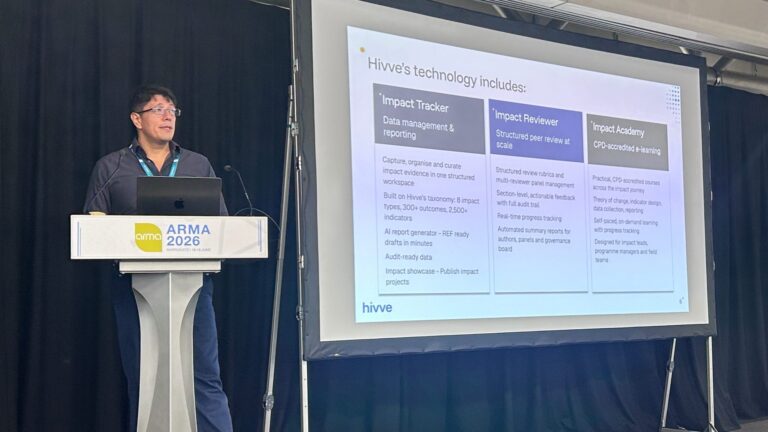
Hivve’s Impact Tracker helps researchers and research offices capture project information, outcomes and supporting evidence as work develops.
This provides a foundation for preparing impact case studies and identifying where further corroboration may be needed.
Explore Hivve’s AI Impact Case Studies solution
A practical timeline for REF 2029 preparation
With the impact eligibility period running to 31 July 2028, research offices have an opportunity to strengthen their evidence before the final stages of preparation.
During 2026: Review potential impact case studies, identify important claims and assess what corroborating evidence is already available.
During 2027: Work with researchers and external partners to address gaps. Capture evidence of emerging outcomes while relationships are active.
During 2028: Review the evidence supporting each case study, verify sources and prepare the narratives for institutional assessment and refinement.
Before submission: Check the latest REF guidance, ensure claims are supported and confirm that appropriate corroborating information and contact details are available.
These are suggested preparation milestones, not official REF deadlines.
The precise timetable should be aligned with institutional processes and published REF requirements.
From evidence collection to stronger case studies
REF 2029 preparation is an opportunity to strengthen how universities capture and manage research impact evidence.
The benefits extend beyond the assessment itself.
Better evidence can help researchers understand the outcomes of their work, support more effective engagement with partners and make future reporting easier.
It can also help research offices identify emerging impact, recognise gaps and support researchers before the final drafting stage.
At Hivve, our approach combines evidence management with AI-assisted drafting and structured human review.
Impact Tracker provides a place to organise project information and supporting evidence. Our AI Report Generator can help turn that information into a draft impact case study and provide recommendations for improvement.
Impact Reviewer supports structured, human-led peer review.
These capabilities support different stages of preparation, but they all depend on the same foundation: credible evidence.
A strong REF impact case study starts long before the writing begins.
Preparing for REF 2029?
Explore how Hivve can help your institution manage impact evidence, prepare case studies and support structured review.
Talk to Hivve about REF 2029 preparation
For more on AI-assisted drafting, read our related article, What AI can and cannot do for a REF impact case study.
Frequently asked questions
Does REF 2029 require external corroboration?
Yes. Impact case studies must include appropriate sources external to the submitting institution that corroborate specific impact claims.
How many corroborating contacts can a REF impact case study include?
Up to five individuals may be entered as corroborating sources. The maximum number of corroborating sources overall is ten, and these can include documentary evidence as well as individuals.
When should universities start collecting corroborating evidence?
Ideally, throughout the impact journey. Capturing evidence while relationships are active can reduce the risk of losing important information before submission.

















































Responses (0)
No responses yet. Yours would be the first.