Can ChatGPT write a REF impact case study?
Yes. Given the right information, ChatGPT and other generative AI tools can produce a structured, convincing draft.
But that raises a more important question.
Can AI produce a strong REF impact case study without the evidence needed to support it?
Not reliably.
For universities preparing for REF 2029, the challenge is not simply writing a persuasive narrative. It is demonstrating the research’s contribution to meaningful change and ensuring that the claims are supported by credible evidence.
AI can make parts of that process considerably easier.
Understanding where it helps, and where human judgement remains essential, is key to using it effectively.
Why not just use ChatGPT?
General-purpose AI tools can help researchers summarise information, organise material and improve the clarity of their writing.
They can also generate draft narratives from notes, reports and project descriptions.
For researchers facing competing demands on their time, this is understandably attractive.
However, there are several considerations for REF managers.
Confidentiality and institutional policies
Impact case studies may involve confidential partner information, unpublished research, commercially sensitive material or personal data.
Before using an AI service, researchers need to understand how that service processes information and whether its use complies with institutional policies.
Different tools and account configurations offer different data protection arrangements.
A tool being readily available does not automatically mean it is appropriate for every type of institutional information.
A convincing narrative is not necessarily an evidenced narrative
Generative AI is designed to produce plausible language.
Where information is incomplete, it may make connections or draw conclusions that are not adequately supported by the underlying material.
For example, a research project may have contributed to a policy consultation.
An AI-generated narrative might present this as evidence that the research changed government policy.
That is a significant difference.
The first describes engagement. The second makes a claim about impact that requires corroboration.
A well-written paragraph cannot compensate for missing evidence.
Evidence provenance
REF preparation involves multiple people, often over several years.
Research offices need to know which sources support particular claims, when evidence was collected and whether it remains available for verification.
General-purpose AI tools can work with uploaded documents and retained project information, depending on their configuration.
But this is not automatically the same as having a structured, institutionally managed record of impact evidence.
For REF preparation, provenance matters as much as the quality of the writing.
Can AI find impact evidence on the web?
AI-powered search tools can be useful for identifying potential sources.
They may find policy documents, public reports, professional guidance or other publications that reference university research.
These sources can provide valuable leads.
But there are important limitations.
A citation is not proof of impact
A policy document citing a research paper may demonstrate that the research was referenced.
It does not necessarily show how the research influenced the decision or what changed as a result.
Additional evidence may be needed to establish the contribution made.
Not all impact evidence is publicly available
Some of the most meaningful evidence of research impact sits with external partners.
A healthcare organisation may have changed its clinical practice. A charity may have adapted its services. A business may have introduced a new process.
These changes may be documented internally or understood by the people involved without appearing in publicly accessible sources.
AI-powered search is necessarily influenced by what it can find.
This creates a risk of prioritising visible information over more significant but less accessible evidence.
A URL cannot replace an external corroborating source
REF 2029 requires appropriate sources external to the submitting institution to corroborate impact claims.
These may include documentary evidence or individuals who can verify particular outcomes.
A web link can be useful, but its relevance must be checked.
It is also important to consider whether the information will remain accessible throughout the REF preparation process.
Websites change, documents move and links disappear.
AI can help identify possible evidence. It cannot remove the need to establish what that evidence actually demonstrates.
For the detailed requirements, see the official REF 2029 Engagement and Impact guidance.
Where can AI make a genuine difference?
Despite these limitations, AI offers valuable opportunities to improve impact-case-study preparation.
It can help researchers:
- Organise existing project information into a coherent structure.
- Summarise lengthy documents and supporting material.
- Develop initial impact narratives.
- Identify potential gaps in the information provided.
- Suggest questions to investigate and additional evidence to seek.
- Improve clarity and consistency during revisions.
These capabilities can reduce the administrative work involved in preparing a first draft.
They can also help researchers and impact professionals focus their attention on the areas that need further development.
At Hivve, we’ve been exploring how AI can support this process while keeping evidence and human judgement at the centre.
Our AI Impact Case Studies solution uses project information and supporting evidence to help generate draft case studies, provide feedback and recommend areas for improvement.
The aim is not simply to produce text more quickly.
It is to help researchers make better use of the information they have already collected.
Why assessment is harder than generation
One of the most important distinctions in impact-case-study preparation is the difference between generating a narrative and evaluating its strength.
Two case studies may be equally well written.
Both may describe research contributing to a change in policy or professional practice.
But one may demonstrate a clear contribution, supported by credible external evidence.
The other may rely on assumptions or describe activity without establishing what changed.
The writing alone does not reveal that difference.
A meaningful review needs to consider the significance and reach of the impact, the research’s contribution and the credibility of the evidence.
AI can help identify possible weaknesses and suggest improvements.
But it should not be assumed that an AI-generated score or assessment is equivalent to informed peer review.
Generating a case study is one task. Judging the strength of the impact and its supporting evidence is another.
This is why Hivve separates AI-assisted drafting from structured human review.
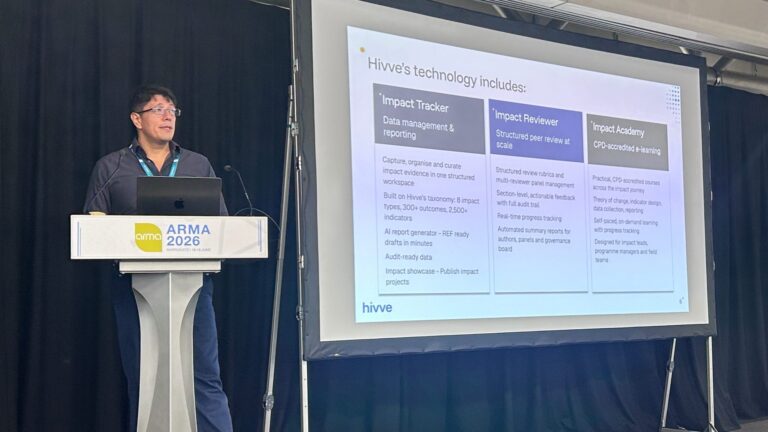
Our AI Report Generator helps researchers prepare drafts and identify potential improvements.
Impact Reviewer provides a structured workflow for human reviewers to assess submissions against defined criteria and record their feedback.
It is not an AI assessment tool.
Both have a role, but they serve different purposes.
What about REF 2029 rules on AI?
Universities should distinguish between the use of AI during preparation and the requirements governing the final REF submission.
Research offices should monitor official REF guidance and ensure that their approach complies with institutional AI, information governance and research integrity policies.
Even where AI-assisted drafting is permitted, responsibility for the accuracy and credibility of the case study remains with the people preparing and submitting it.
This means checking generated content, verifying sources and ensuring that claims do not exceed what the evidence supports.
The same principles apply whether researchers use a general-purpose AI service or a specialist application.
Responsible AI matters
AI can help reduce the time spent preparing impact reports, but universities also need confidence in how their information is handled.
Questions about confidentiality, data processing, model training and human oversight are particularly important where institutional or partner information is involved.
Hivve’s approach is to combine AI capabilities with clear governance and human responsibility.
You can read more about our commitments and safeguards in Our Approach to AI.
Better REF preparation starts with better evidence
AI has considerable potential to make impact-case-study preparation more efficient.
But its greatest value may not be the speed at which it produces a draft.
It may be helping researchers identify what they know, what they can demonstrate and where they need to strengthen the evidence.
For REF managers, that is a more useful starting point than asking whether ChatGPT can write a case study.
The question is how AI can support a process that produces credible, well-evidenced submissions.
AI can help tell the story. The evidence needs to support it, and expert judgement needs to test it.
Explore AI-assisted REF impact-case-study preparation
Hivve combines structured evidence management, AI-assisted drafting and human-led review to support universities preparing for REF 2029.
Explore Hivve’s AI Impact Case Studies solution
For a broader perspective, read Beyond reporting: How AI can transform impact practice.
Frequently asked questions
Can ChatGPT write a REF impact case study?
Yes. ChatGPT can help produce a draft, but the content must be checked against credible evidence and relevant institutional policies.
Can AI find corroborating evidence for REF 2029?
AI-powered search can identify potential sources. Researchers must verify whether those sources corroborate the specific impact claims being made.
Can AI assess a REF impact case study?
AI can provide preliminary feedback against specified criteria, but this should not replace structured assessment and expert peer review.

















































Responses (0)
No responses yet. Yours would be the first.